How grain at the experiment farm has shrunk over the years
By Laura Weingartner
When asked why the grain grown on the University of Alaska Fairbanks’ experiment farm was so much taller in 1916 compared to 2024, Jakir Hasan had a simple explanation. “People were a bit shorter,” he joked.
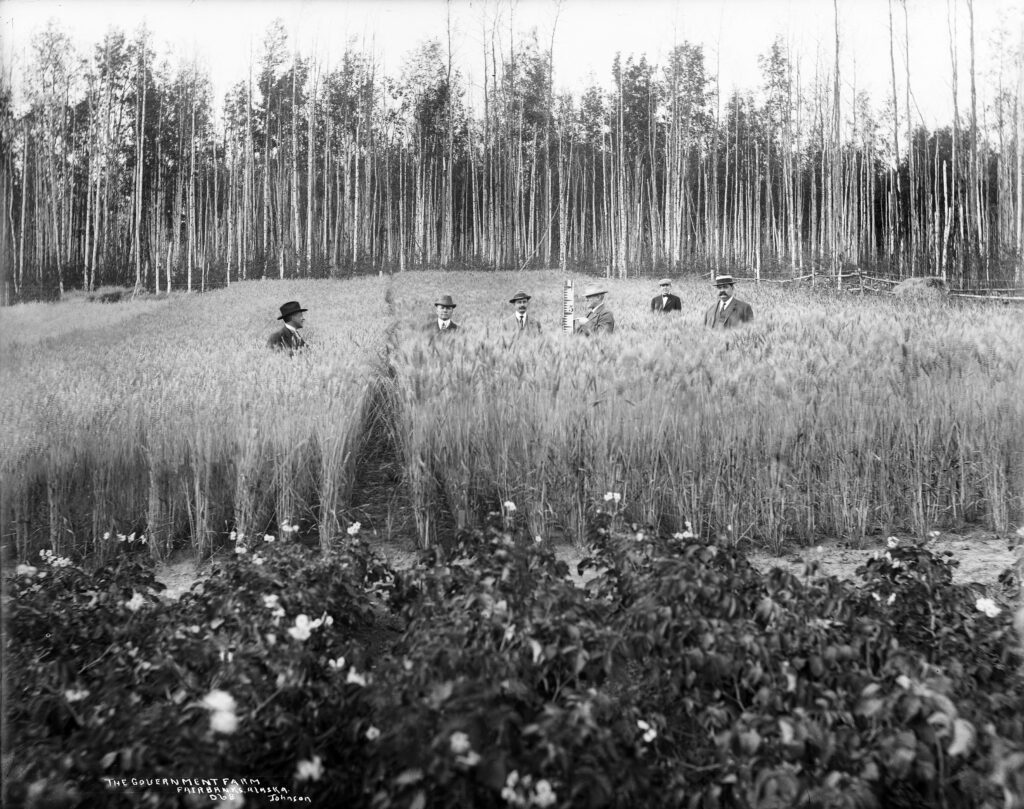
A group of early agriculture boosters in the Tanana Valley measure the height of grain grown at the Fairbanks Agricultural and Forestry Experiment Station in the early 1900s. The stick shows a measurement between 4 and 5 feet.
Hasan, research assistant professor of plant genetics at UAF’s Institute of Agriculture, Natural Resources and Extension, explained that it had to do with a shift to short cereal grain breeding that began in the mid-20th century as part of the Green Revolution, a period during which new technologies, such as high-yielding varieties of grain, dramatically increased food production globally.
Traditionally, wheat varieties were tall (over 4 feet) and prone to falling over, or lodging, when fertilized heavily with nitrogen. Nitrogen encouraged excessive growth and made crops more vulnerable to wind and rain damage, leading to yield losses. By using less nitrogen fertilizers, farmers prevented the plants from growing too tall, but also limited the amount of food the land could support.
A dwarf wheat variety called Norin 10 Wheat, bred in Japan, was brought to the U.S. in 1945, where it was used to develop high-yielding, disease-resistant semi-dwarf wheat that was subsequently distributed worldwide. These shorter varieties were less likely to lodge, so farmers could apply more fertilizer and produce more food.
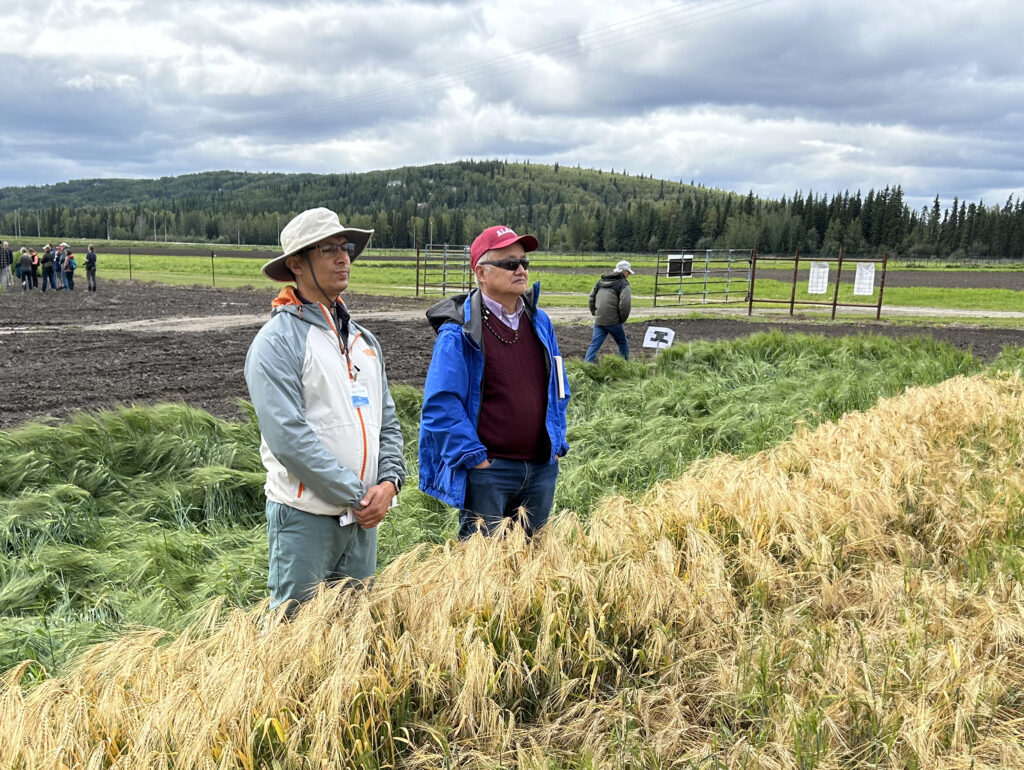
Jakir Hasan stands with Mingchu Zhang, professor emeritus of agronomy and soil sciences with UAF’s Institute of Agriculture, Natural Resources and Extension, in a field of semi-dwarf barley on the Agricultural and Forestry Experiment Station on UAF’s Fairbanks campus.
There are other advantages to growing semi-dwarf (2 to 4 feet) and dwarf (below 2 feet) cereal grains. Shorter plants can support heavier heads of kernels, and more energy goes into grain production rather than stem growth, resulting in less water use. Shorter varieties use nitrogen more efficiently than tall varieties; they can be planted closer together, increasing yield per acre, and many modern varieties have been bred with resistance to rust, blight and other diseases.
The Fairbanks Agricultural and Forestry Experiment Station was started in 1906 to find crops that could grow in the Interior. Early researchers grew vegetables and various types of brome, oats, barley and wheat — the tall varieties at first.
Variety trials continue today, and Hasan runs a breeding program, developing grain varieties that can be commercially successful in Alaska for human food, animal feed and varieties that can be used in breweries and distilleries.
People may or may not have been shorter in the early 20th century, but they were planting much taller grain. Today, traditionally tall varieties still exist in some areas, but semi-dwarf and dwarf varieties dominate modern agriculture due to their efficiency and productivity.
