By Laura Weingartner
It’s the first week of May, and Caley Gasch is elbow-deep in a raised bed in a high tunnel in Juneau. She’s collecting a soil core from one of five sites across the state as part of a study addressing how land use change affects soil properties and functions.
Gasch is a soil scientist with the University of Alaska Fairbanks Agricultural and Forestry Experiment Station. She has spent the last few years working with farmers, home gardeners and community and tribal agriculture projects collecting soil samples to create an inventory of soil conditions.
From farm visits and mail-in samples, Gasch has over 600 samples from areas on and off the road system. Each sample was analyzed for properties that show how healthy the soil is, including nutrient content, organic matter, pH level, nitrogen content and even electrical conductivity. This analysis allowed Gasch and her team to provide participants with individualized reports that gave practical advice on improving or managing soil conditions.
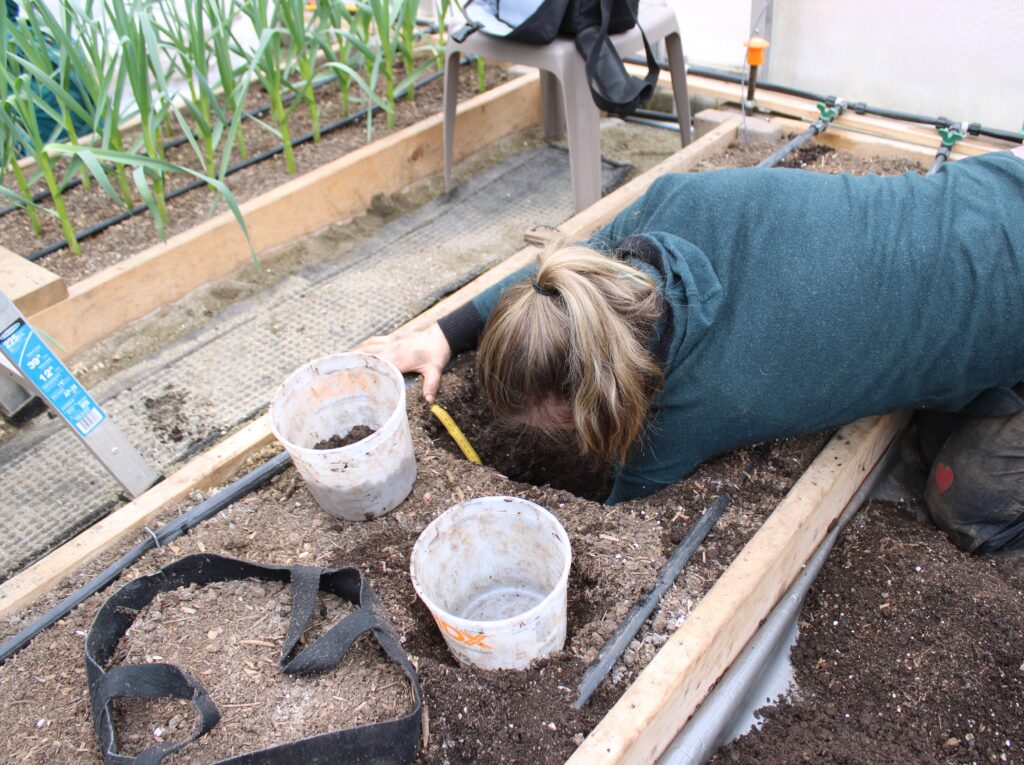
Caley Gasch collects a soil sample inside a high tunnel at a farm in Juneau.
While this dataset provides information on the chemical nature of the soil, Gasch also wants to understand the physical and biological properties. Soil is a mixture of minerals, organic matter, living organisms, gas and water. To get a more complete picture of soil properties, Gasch is resampling 20 farms that span Alaska’s agricultural regions, including the farm in Juneau. She is measuring components to better understand the microbial community (which includes bacteria, fungi and protozoa), how well the soil structure resists water erosion, and how compact the soil is, which can affect water infiltration, root growth and aeration. These characteristics help determine the health of the soil.
“A healthy soil supports plant life, and the life of soil critters, which requires a mix of air and water, drains well — doesn’t stay saturated and mucky— and has sufficient organic matter and nutrients to support the life within it,” Gasch said. It is also free of toxins, has near-neutral pH and is protected from erosion.
“If a soil is eroding, nothing else matters because it is in an active state of degradation,” Gasch said.
Understanding these characteristics allows Gasch to assess the condition of Alaska’s agricultural soils and compare them to soils in other regions of the country. This data can also reveal potential areas to expand agriculture and address food security and food sovereignty concerns.
Soil health changes as land use shifts
With a warming climate, agricultural opportunities are expanding. Because of climate change and land use shifts, Gasch also wants to understand how and why soil changes over time. To do this, she is installing more intensive monitoring projects on five farms around the state that represent unique regions: Juneau (Southeast), Homer (Kenai Peninsula), Palmer (Southcentral), Fairbanks (Interior), and Pilgrim Hot Springs (Seward Peninsula).
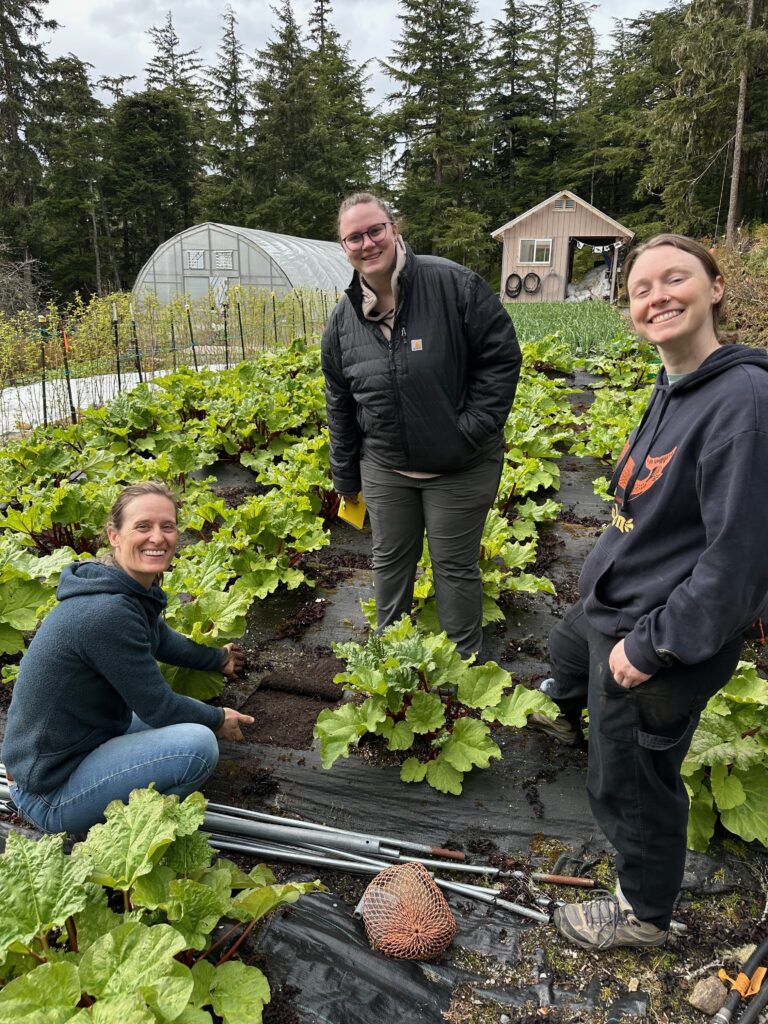
Caley Gasch (left), Rebecca Collins, a PhD student in UAF’s Natural Resources & Environment program (center), and Victoria Monsaint-Queeney (right), AFES data analyst and technician, prepare to dig a soil pit and collect soil at a farm growing rhubarb in Juneau.
At each farm site, Gasch and her team will dig soil pits, install soil sensors and take samples at three adjacent land use areas: forest or tundra, open field agriculture land and land within a high tunnel or a similar structure. In collaboration with the U.S. Department of Agriculture Natural Resources Conservation Service, she will measure soil function properties throughout the growing season, such as carbon cycling and microbial activity, in addition to the properties measured for the soil inventory.
The data collected from these sites will be used to understand how the soil changes as land is cleared for agriculture, or if a high tunnel is added to an already farmed field. It can help develop soil management plans tailored to Alaska.
“Our climate (and our soil climate), our styles of farming and gardening, and the soil’s origin are different from most places at more southern latitudes,” Gasch said. “Guidance developed for soil management elsewhere doesn’t necessarily translate to our environments.”
Gasch is collecting the data to provide locally relevant recommendations to support healthy ecosystems.
“Soil is a non-renewable resource, once it is lost or degraded it cannot serve as the foundation for a productive ecosystem,” Gasch said.

Erik M Johnson
August 5, 2025 — 10:00 pm
“This data can also reveal potential areas to expand agriculture and address food security and food sovereignty concerns.” I’m looking forward to hearing what areas we should expand into. 🙂