By Laura Weingartner
Budding chefs got a taste of science this June. With tomatoes grown as part of an experiment to optimize greenhouse productivity, participants in the University of Alaska Fairbanks Summer Session programs, Seasoned Chef Camp and Baking Blitz Camp, made homemade pizza sauce and French tomato galettes.

Students participating in the UAF Summer Sessions Baking Blitz Camp hold up tomatoes grown as part of an experiment to optimize greenhouse productivity.
“The kids loved it,” said Sean Walklin, one of the instructors for the camp and lead chef and program coordinator for the University of Alaska Fairbanks Community and Technical College Culinary Arts and Hospitality Program.
Walklin has been getting tomatoes and bell peppers cultivated in the Agricultural and Forestry Experiment Station greenhouse, attached to the Arctic Health Research Building on the Troth Yeddha’ Campus, since 2023. The tomatoes, grown and provided by UAF horticulture Professor Meriam Karlsson, are part of ongoing research into efficient greenhouse crop production in Alaska.
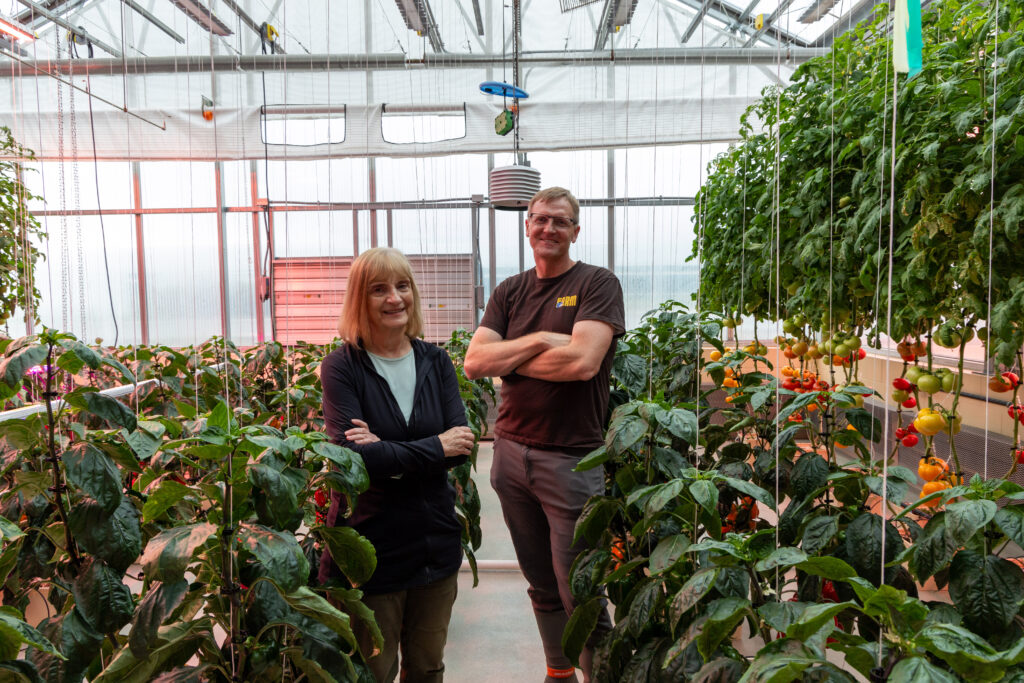
Meriam Karlsson, a UAF professor of horticulture, and Eric Cook, a Greenhouse Research Professional, stand in the AFES greenhouse surrounded by tomato and bell pepper plants that have been grown for lighting experiments.
Karlsson grows bell peppers and tomatoes year-round, even through the winter when seasonally short days and low sun angles make natural light unreliable. Her research uses innovative lighting strategies to maximize plant production while optimizing energy use. She experiments with lighting inside the plant canopy (rather than just light from above), and has found that this inter-canopy lighting increases both the yield and fruit size in certain tomato varieties.
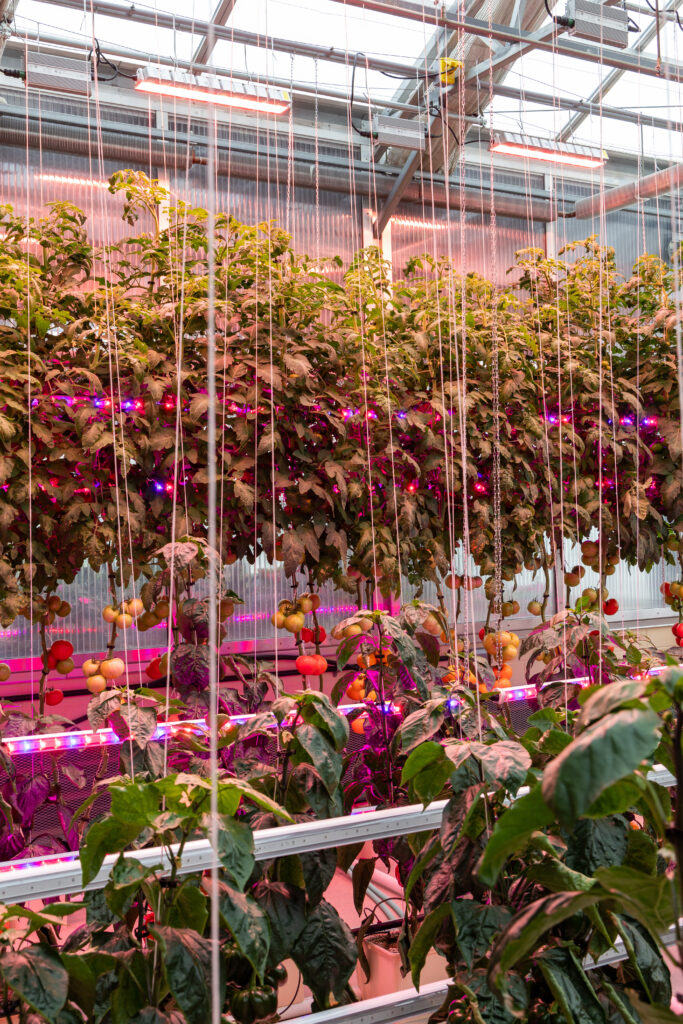
Inter-canopy LEDs light up tomato and bell pepper plants growing in the AFES greenhouse.
In the past, Karlsson has designed trellising and pruning experiments on bell peppers and devised strategies that produced significantly more peppers per plant. She said donating the subjects of these experiments to the culinary program makes a lot of sense.
“It’s a good collaboration,” she said. “We can support them and they are educating our students.”
Walklin reached out to Karlsson because he was having a hard time sourcing good-quality produce in the winter. Last year, around 700 pounds of produce were delivered to the culinary program.
Walklin likes to source local products when he can, but the window to buy local tomatoes in Fairbanks is narrow.
“What’s special about these tomatoes is that they come in the dead of winter,” Walklin said. “They taste like summer.”
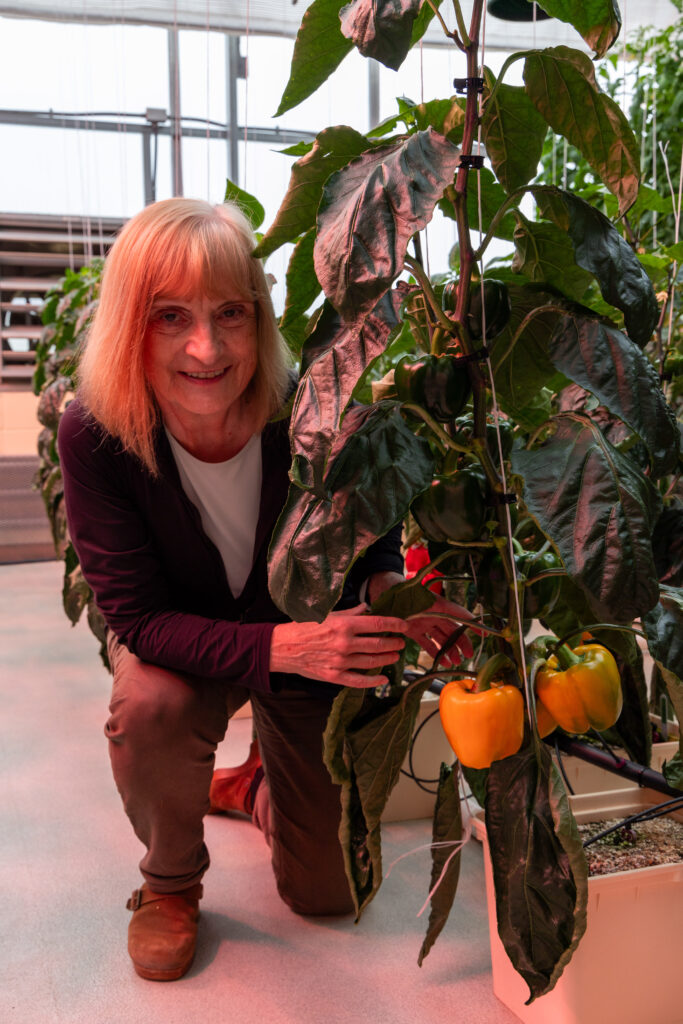
Meriam Karlsson shows ripening bell peppers she’s growing in the AFES greenhouse.
From the dead of winter to mid-summer, Walklin can use the greenhouse produce. He and his students also showcase the produce at the Borealis Bistro, the student-run restaurant that opens each spring. This year’s menu featured the greenhouse tomatoes in a Caprese salad and the peppers in a roasted red pepper sauce.
“We feature them all over the menu,” Walklin said. He uses them wherever he can to highlight local ingredients and instill in his students a sense of place.
For Walklin, the collaboration is about more than good food, it’s also about students learning about the work of connecting with producers.
“You’re connecting with people who put great work in and you get a great product out to the public,” he said.
