By Laura Weingartner
Four researchers from the Institute of Agriculture, Natural Resources and Extension are presenting their research posters this week at the fall meeting of the American Geophysical Union in Washington, D.C. The AGU meeting draws more than 25,000 attendees from more than 100 countries annually.
These four researchers all study the health of the boreal forest. If you’re attending AGU this week, stop by their posters and learn more!

Jessie Young-Robertson, research associate professor of forest ecology and co-director of the Forest Soils Laboratory at the Fairbanks Agricultural and Forestry Experiment Station, is presenting on her research on how drought and stress from beetle infestation affects when and if a tree dies. Spruce beetle attacks in Alaska have impacted more than 2.17 million acres since 2016 and drought conditions are tipping the balance in favor of the beetles, leaving host trees struggling to survive.
Jessie and her team have been monitoring trees in the early stages of attack in the Alaska Range. Their research shows, among other findings, that infested trees die because their ability to move water through the trunk and their overall water content declines. Trees with higher water content are able to better defend themselves from an infestation and are less likely to die, thus drier conditions make it even harder for trees to cope.
This research helps us better understand how boreal forests bounce back from beetle infestations, providing insights for forest management and climate resilience.
Interested in learning more about Jessie’s research? Visit her website!
Time Series Analysis of Forest Mortality Trends Using Satellite Imagery and Ground-Based Data in Boreal Forests, Interior Alaska.
Anushree Badola, an AFES post-doctoral fellow, is sharing her work using satellite images from 2014 onward to track tree deaths in the Bonanza Creek Experimental Forest near Fairbanks, Alaska.

Alaska is warming twice as fast as the rest of the world, which is causing problems for its forests. The rapid warming is leading to droughts, slower tree growth, and more trees dying. To tackle these issues, Anushree and her collaborators work to combine satellite images with weather data and ground observations. They look at how changes in weather, like temperature and rainfall, affect tree health and to ultimately find out what is causing the trees to die.
Work like hers provides useful information to groups like the U.S. Forest Service, the Alaska Department of Natural Resources, and public and private landowners so they can manage forests better and develop policies to protect the forests against climate change.
Katherine Mahon, an AFES research technician in the Forest Soils Laboratory, is presenting her work on using leaf spectroscopy alongside other field measurements (like leaf area, water content, and pigment content) to help study how the boreal forest responds to environmental change, such as bark beetle and leaf miner damage.
Leaf spectroscopy uses light to measure chlorophyll content in leaves and needles. Katherine combines her spectroscopy measurements with plant physiological traits associated with stress, pathogen response, productivity, and water balance to validate and interpret indices calculated from satellite data.
Validating indices ensures the interpretations of plant physiology are accurate and reliable in the particular environment being studied. It also allows for remote sensing to be used in remote and difficult-to-access areas, like much of Alaska.
Her findings include that spectroscopy signatures for white spruce that were infected with bark beetles were different from those from non-infected spruce. She also saw differences in indices between insect-damaged and non-damaged aspen leaves.
This study contributes to the library of spectroscopy indices for boreal species, including trembling aspen (with/without leaf miner damage), paper birch, white spruce (with/without bark beetle infestation), black spruce, dwarf birch, and alder.
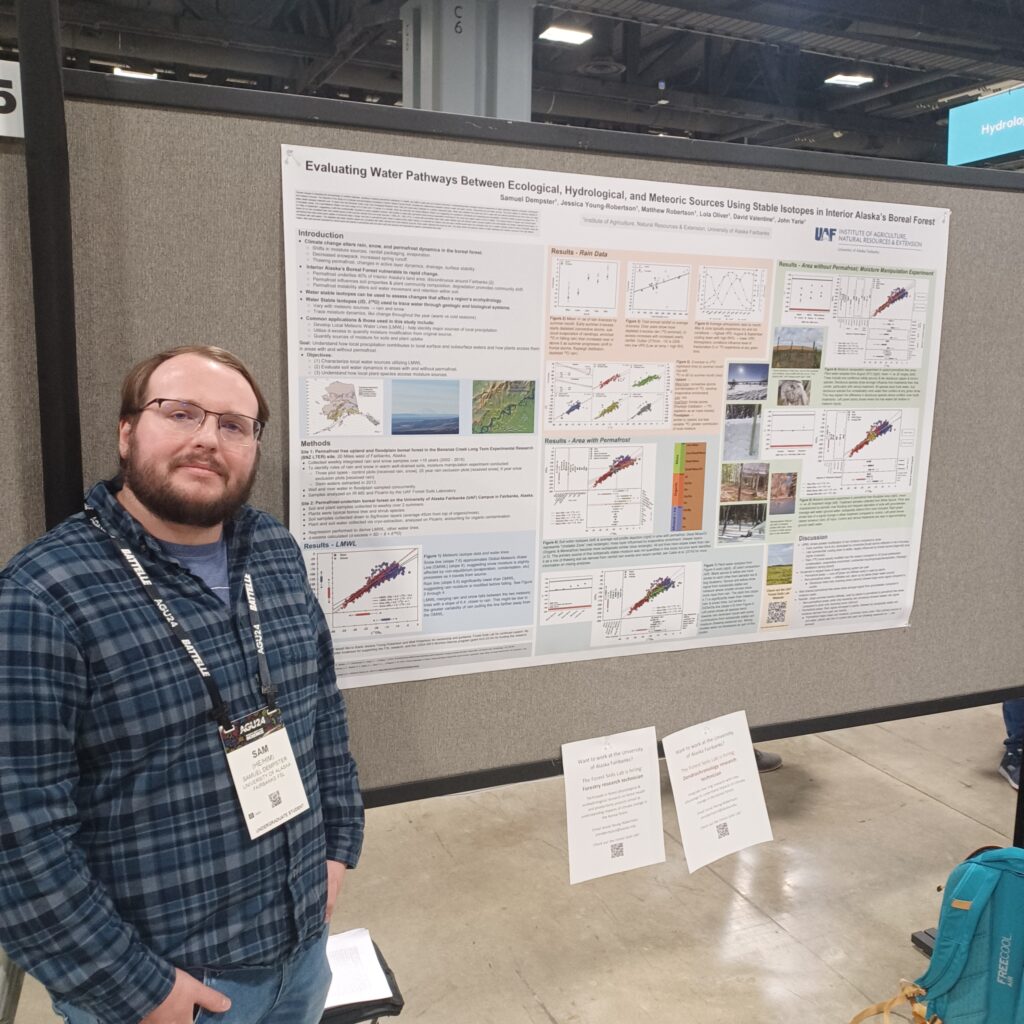
Samuel Dempster, an AFES research technician in the Forest Soils Laboratory, is sharing his research on the interactions between water and the ecological system in Interior Alaska’s boreal forest — a study called ecohydrology.
Climate change is impacting the ecohydrology of northern latitudes, resulting in thawing permafrost, alterations in rainfall, and shifts in plant and soil moisture dynamics. Dempster works to assess the pathways of water between these different sources using data collected over 10 years from the Bonanza Creek Long Term Ecological Research area.
His extensive dataset includes water stable isotopes collected from precipitation, water from plants and soil in areas with and without permafrost, and rivers and wells in floodplain areas. He uses this information to show the dynamic nature of water pathways and moisture sources in this high-latitude region.
